
This article is part two of our series on the role of MSG in agricultural formulations. In the first part, we explore why glutamate remains relevant and how its quality, consistency, and origin can influence formulation performance.
When developing a new agricultural formulation, attention often focuses on the composition of the ingredients.
What is the concentration?
What is the chemical composition?
What results does it deliver?
However, there is another equally important question that often receives less attention:
Where does the raw material come from, and how is it manufactured?
The answer can make a significant difference in areas such as consistency, stability, traceability, technical documentation, and the ability to reproduce results at commercial scale.
In agricultural formulation, origin matters.
And it is becoming increasingly important.
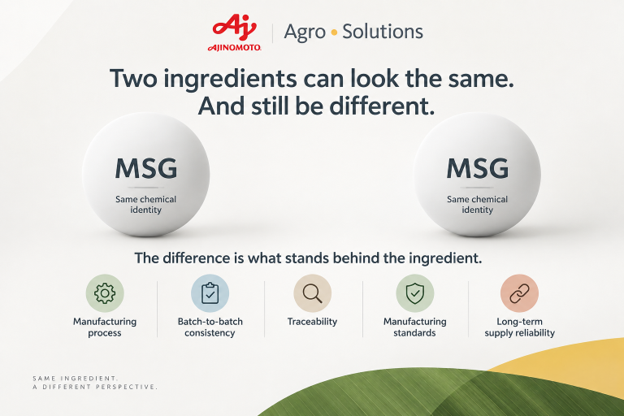
Two Ingredients Can Look the Same and Still Be Different
At first glance, two raw materials may have exactly the same chemical identity.
However, formulation teams know that the real differences often lie in less visible factors:
- the manufacturing process;
- the quality of the raw materials used;
- the control systems in place;
- batch-to-batch consistency;
- traceability;
- the technical documentation available;
- long-term supply capabilities.
These variables directly influence formulation reproducibility and the ability to maintain consistent performance once a product reaches the market.
That is why selecting a raw material involves more than evaluating a technical specification.
It means evaluating the reliability of the system behind it.
Fermentation as a Technology Platform
Fermentation is one of the most established technologies for producing amino acids and other functional compounds.
Unlike other industrial processes, fermentation can produce highly defined molecules through controlled and reproducible biological processes.
However, the true competitive advantage does not lie in the technology alone.
It lies in the knowledge accumulated through decades of working with that technology.
Strain optimization, production processes, purification, quality control, and industrial scalability are the result of years of experience and continuous improvement.
For this reason, when a company evaluates raw materials produced through fermentation, it is evaluating much more than a molecule.
It is evaluating a platform of knowledge.
Missed the first part? Discover why glutamate still matters in agricultural formulation and what makes it a valuable raw material for product development.
More Than a Century of Experience with Glutamate
Few companies have a history as closely connected to glutamate as Ajinomoto.
For more than a century, the company has developed expertise in the production, purification, quality control, and industrial-scale applications of glutamate.
This journey has built extensive expertise in fermentation and amino acids that continues to create new opportunities for innovation.
Perhaps even more importantly, the knowledge accumulated around glutamate has also contributed to a deeper understanding of other closely related molecules.
Beyond Glutamate: The Value of Accumulated Knowledge
Innovation rarely happens in isolation.
More often, it is built on decades of observation, research, and development.
Industrial experience with glutamate has contributed to knowledge of related compounds that are now attracting interest across different formulation approaches.
One example is pyroglutamic acid (PCA), a molecule closely related to glutamate metabolism and part of different research and development approaches in the fields of amino acids and plant physiology.
Beyond any single molecule, this example shows how a mature technology platform can generate new opportunities for innovation through accumulated knowledge.
And it is precisely this depth of technological expertise that distinguishes a raw material manufacturer from a true innovation partner.
The Role of Manufacturing Standards
The quality of a formulation depends on the quality of its components.
But it also depends on the quality of the processes used to produce them.
That is why manufacturing standards play a fundamental role.
For companies operating in international markets, factors such as:
- batch-to-batch consistency;
- process control;
- documented traceability;
- specification stability;
- regulatory compliance;
- supply reliability;
are just as important as the technical characteristics of the ingredient itself.
Working with raw materials backed by rigorous manufacturing processes can help reduce uncertainty and facilitate the development of products for increasingly demanding markets.
From Industrial Expertise to Agricultural Formulation
Modern agricultural formulation requires combining functional raw materials with specialized technical expertise.
Selecting promising ingredients is not enough.
It is essential to understand how they interact, how they behave within a formulation, and how they may perform under real-world conditions.
For this reason, expertise in fermentation provides value that extends far beyond raw material production.
It can contribute:
- knowledge of biological mechanisms;
- understanding of metabolic processes;
- formulation expertise;
- technical support;
- a long-term perspective.
This combination helps transform individual ingredients into solutions designed to address real market needs.
Why Origin Will Continue to Matter More
As agriculture evolves, the pressure to improve efficiency, sustainability, and quality continues to increase.
In this environment, development teams need to reduce risk and increase confidence in the raw materials they select.
That is why questions such as these are becoming increasingly relevant:
- Who manufactures this ingredient?
- How is it produced?
- What expertise stands behind it?
- Can the same quality be guaranteed five years from now?
- Is specialized technical support available?
The answers to these questions can determine the success of a formulation long before it reaches the field.
Conclusion
Raw materials should not be evaluated solely on their chemical composition.
They should also be evaluated based on the knowledge, experience, and manufacturing standards behind them.
The history of glutamate demonstrates how more than a century of fermentation expertise can create value far beyond a single molecule.
Because in agricultural formulation, true innovation does not always mean discovering something new.
Often, it means gaining a deeper understanding of what has already demonstrated its value over generations.
Looking for Raw Materials Backed by Experience and Technical Expertise?
If you are developing new agricultural formulations or evaluating ingredients for your next project, our team can help.
Contact AgroSolutions or fill out our form to discover how our expertise in fermentation, formulation, and product development can support your next innovation.