
Plant physiology as the starting point for agronomic innovation
Modern agriculture faces a combination of technical and production-related challenges linked to sustainability, resource-use efficiency, and the need to maintain yield stability under increasingly demanding and variable environmental conditions. In this context, applied research in plant physiology has become a central element in the development of reliable and reproducible agronomic solutions.
At Ajinomoto AgroSolutions, the development of biostimulant solutions is based on a fundamental principle: understanding how plants respond at a physiological level to a given agronomic intervention. Only through this knowledge is it possible to design formulations capable of acting in a precise, measurable, and consistent manner on the processes that regulate growth, resource use, and stress tolerance.
As part of our research and development program, we combine physiological analysis tools and omics techniques to evaluate plant responses under controlled conditions. Within this framework, advanced photosynthetic analysis systems play a key role by enabling the direct quantification of critical parameters of plant function.
Photosynthetic analysis and plant physiology: why it matters
The effectiveness of a biostimulant solution cannot be evaluated solely through visual parameters or phenotypic measurements. Its real value lies in its ability to modulate internal physiological processes that are often not visible to the naked eye, especially during early stages of crop development.
- Among the most relevant physiological processes are:
- Photosynthetic efficiency and carbon assimilation
- Regulation of gas exchange
- Control of transpiration and plant water balance
- Physiological response to abiotic stress
- Utilization of light energy
Advanced photosynthetic analysis tools make it possible to evaluate these processes quantitatively, under controlled and reproducible conditions, providing key information for agronomic and formulation decision-making.
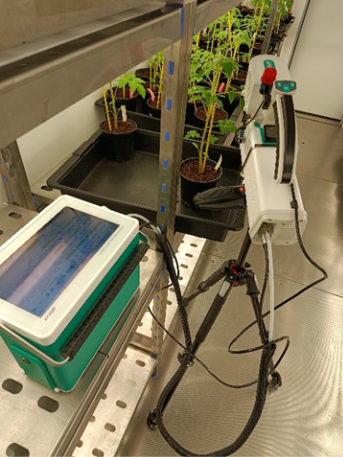
What an advanced photosynthetic analysis system provides
An advanced photosynthetic analysis system is a scientific tool designed to measure gas exchange between the leaf and the atmosphere and to evaluate the functional efficiency of the photosynthetic apparatus.
This type of instrumentation allows the quantification of key plant physiology parameters, including:
- Net CO₂ assimilation rate
- Transpiration and stomatal conductance
- Internal leaf CO₂ concentration
- Photochemical efficiency through chlorophyll fluorescence
A key advantage of these systems is precise control of the microenvironment during measurement. Variables such as CO₂ concentration, light intensity, temperature, and humidity can be tightly regulated, ensuring data reproducibility and enabling the simulation of different environmental scenarios.
Integrating photosynthetic analysis into new formulation development
Photosynthetic analysis is integrated into experimental designs based on clearly defined physiological hypotheses. Each trial starts from specific technical questions aimed at understanding plant behavior under different formulations.
Examples include:
- How does a given formulation affect photosynthetic efficiency under optimal conditions?
- Is photosynthetic activity maintained under water stress?
- Is there an improvement in water use efficiency associated with changes in stomatal conductance?
Trials are designed with defined treatments, appropriate controls, and sufficient replication to ensure statistical validity and reproducibility of results.
Measurement under controlled conditions
Plants are grown in growth chambers under regulated and adjustable environmental conditions. Physiological measurements are performed directly on the plant following standardized protocols.
During each measurement, key parameters are recorded in real time, including:
- Net photosynthesis
- Stomatal conductance
- Transpiration
- Water use efficiency
- Photochemical performance of the photosynthetic apparatus
These data make it possible to identify clear physiological differences between treated and untreated plants, even before visible changes in growth or development occur.
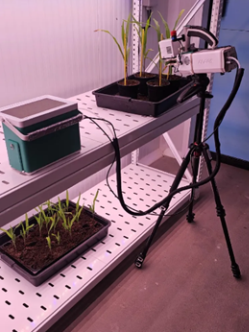
High-precision physiological data as the basis for scientific validation
The use of advanced photosynthetic analysis systems provides high-precision physiological data that form the scientific foundation of our solution development.
Across multiple internal trials, plants treated with formulations developed by Ajinomoto AgroSolutions have shown consistent improvements in CO₂ assimilation compared to untreated controls.
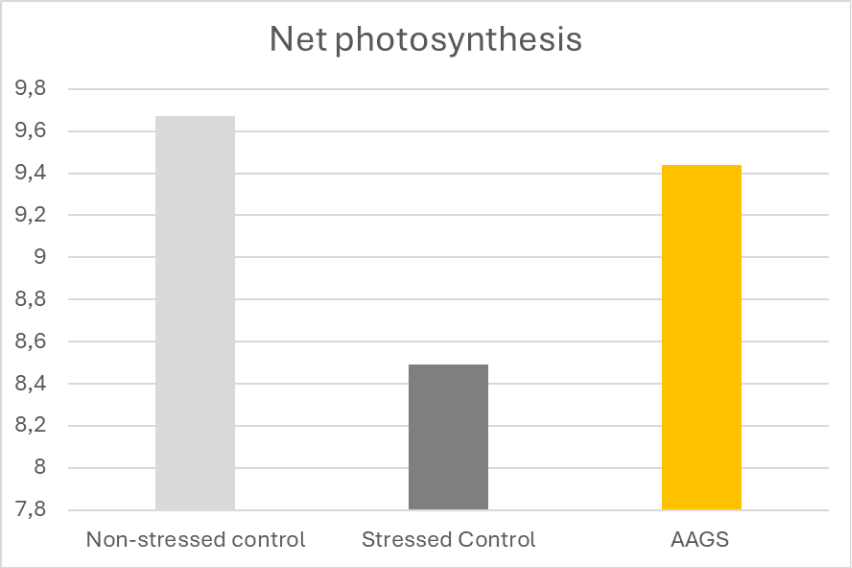
In a representative example under controlled stress conditions, untreated plants showed a reduction in net photosynthesis of approximately 13%. In contrast, plants treated with our formulation exhibited an 11% recovery, reaching values very close to those observed in non-stressed plants.
These results allow for objective evaluation of carbon fixation efficiency and support the selection of the most appropriate formulations based on crop, environment, and agronomic objective.
Physiological response to environmental stress
Measurement of stomatal conductance is a key indicator for analyzing plant responses to stress conditions. Under moderate water deficit, physiological data show that treated plants maintain a more efficient balance between photosynthesis and transpiration.
In addition, chlorophyll fluorescence parameters indicate a better functional state of the photosynthetic apparatus, suggesting a greater capacity to maintain energy metabolism under adverse conditions.
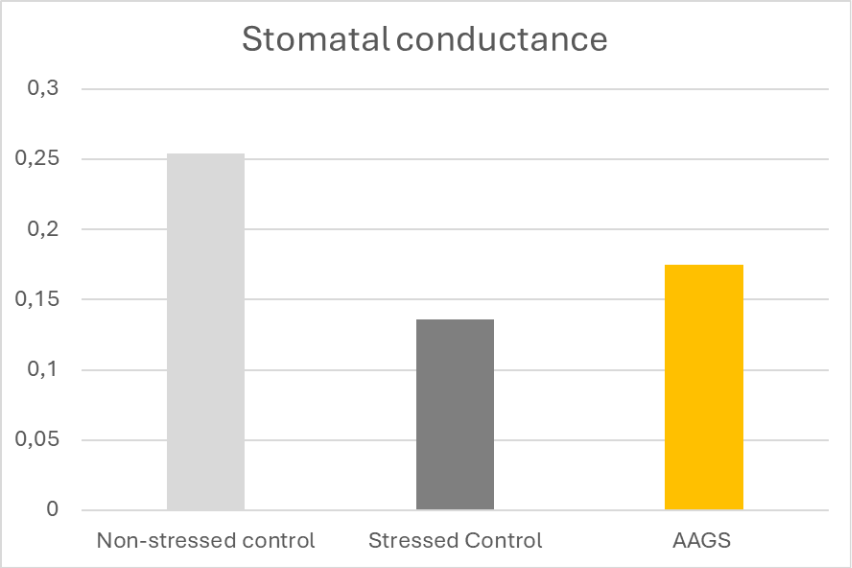
In one of the trials conducted, stress reduced stomatal conductance by 47% compared to the non-stressed control. Under the same conditions, application of a formulation developed by Ajinomoto AgroSolutions reduced this impact by 15%, indicating a more efficient physiological adjustment.
From physiological research to formulation
Data obtained through photosynthetic analysis are directly integrated into the formulation development process.
This information enables us to:
- Objectively compare formulations
- Optimize application rates and timing
- Identify physiological modes of action
- Reduce technical uncertainty in agronomic decision-making
The result is a development process grounded in physiological evidence, delivering solutions designed to perform consistently and reproducibly under field conditions.
Conclusion
The integration of advanced photosynthetic analysis into our research program reinforces an approach based on applied science, precision, and reproducibility. Direct measurement of plant physiology allows us to validate solution performance, optimize development, and support technical decisions with objective data.
At Ajinomoto AgroSolutions, innovation is built on reliable physiological data—because only what is measured with precision can be improved consistently.
If you would like to receive further information or learn how we apply physiological and photosynthetic analysis in the development of biostimulant solutions, we invite you to contact our team. Complete the form to receive technical information tailored to your needs.