
OD formulations (Oil Dispersion formulations) continue to play a critical role in crop protection, particularly for active ingredients that are sensitive to water and require stable performance throughout storage, dilution, and field application.
However, formulation requirements are evolving rapidly.
Higher active loadings, multi-active systems, and the growing use of biological and microbial formulations are placing greater demands on dispersion stability, emulsification behavior, rheological balance, and compatibility within OD systems.
As formulation complexity increases, maintaining consistent formulation behavior throughout storage through to application becomes significantly more challenging.
The Challenge Is No Longer Isolated
Most OD formulation challenges do not arise from individual components alone.
They are often driven by interfacial behavior within the formulation system.
This becomes particularly critical in:
- Higher active loadings
- Multi-active combinations
- Microbial applications
In these systems, small imbalances can result in:
- Sedimentation during storage
- Instability after dilution
- Compatibility-related constraints
- Inconsistent formulation behavior during application
As a result, formulation stability increasingly depends on how interfacial behavior is managed across the system.
Why Interfacial Behaviour Matters
OD formulations involve two key interfaces:
- The solid–oil interface, associated with particle wetting and dispersion stability
- The oil–water interface, which becomes critical during dilution and emulsification
Traditionally, OD formulations have often relied on separate dispersing and emulsifying agents to address these requirements.
While effective in some applications, this approach can increase formulation complexity and introduce additional compatibility constraints as systems become more demanding.
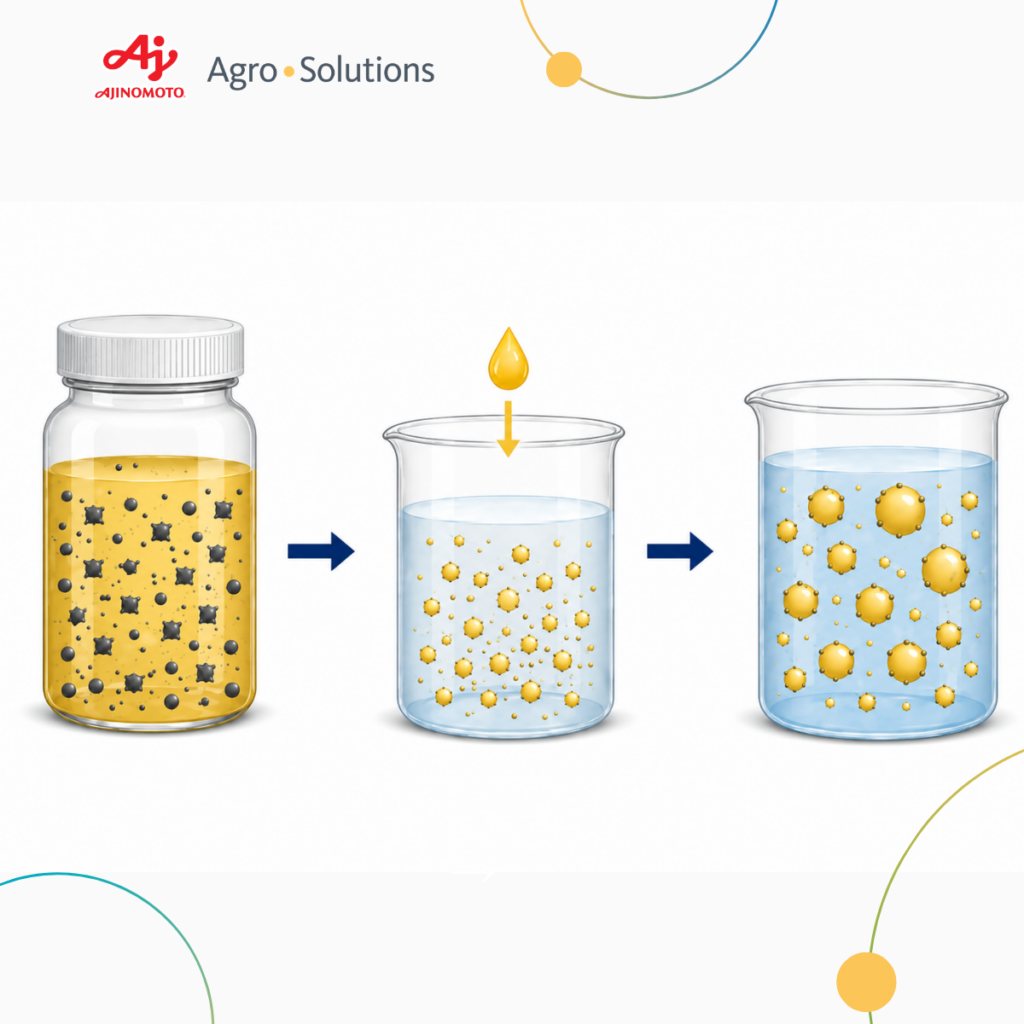
This is why integrated surfactant approaches are attracting increasing attention.
Rather than relying on multiple independent additives, Tensiofix® dual-function surfactants can help support more coordinated behavior across both interfaces during storage, dilution and application.
Where This Becomes Most Relevant:
The importance of interfacial control becomes critical in OD formulations with :
- Higher solid content
- More complex active combinations
- Biological and microbial formulations
In these systems, formulation stability is no longer only about selecting the right components.
It is about maintaining balanced formulation behavior under increasingly demanding conditions.
This includes:
- Sedimentation control during storage
- Emulsion stability after dilution
- Compatibility across multiple actives
- Controlled rheological behavior
Supporting Reliable OD Formulation Design?
At AgroSolutions Tensiofix®, our work with OD formulations has shown that long-term formulation stability depends on how dispersion, emulsification, and rheological behavior are balanced across the formulation system.
By combining formulation expertise with integrated surfactant approaches including Tensiofix® dual-function surfactants, it is possible to support stable dispersion, effective emulsification within increasingly complex OD formulations.
As formulation requirements continue to evolve, interfacial control is becoming less an isolated optimization step and more a fundamental aspect of reliable OD formulation design.
In complex OD formulations, performance is rarely determined by a single component alone, but by how the formulation system functions as a whole.
Ajinomoto AgroSolutions Tensiofix® combines expertise in surfactant and co-formulant technologies with long-term experience in formulation development, supporting customers in addressing increasingly complex formulation challenges.