
The evaluation of biostimulants through field trials is a key tool to validate their agronomic efficacy and their consistency from a plant physiology perspective. Compared to isolated assessments or controlled conditions, trials conducted under real cultivation conditions make it possible to analyze crop responses across different soil–climate scenarios and stress situations.
In this context, continuous technical monitoring of field trials provides essential information to correctly interpret results and to integrate the data obtained into development processes and decision-making.
With this objective, the technical team recently carried out several visits to field trials developed by specialized external companies, focusing on horticultural and broadacre crops in southeastern Spain.
Agronomic evaluation in potato under water stress conditions
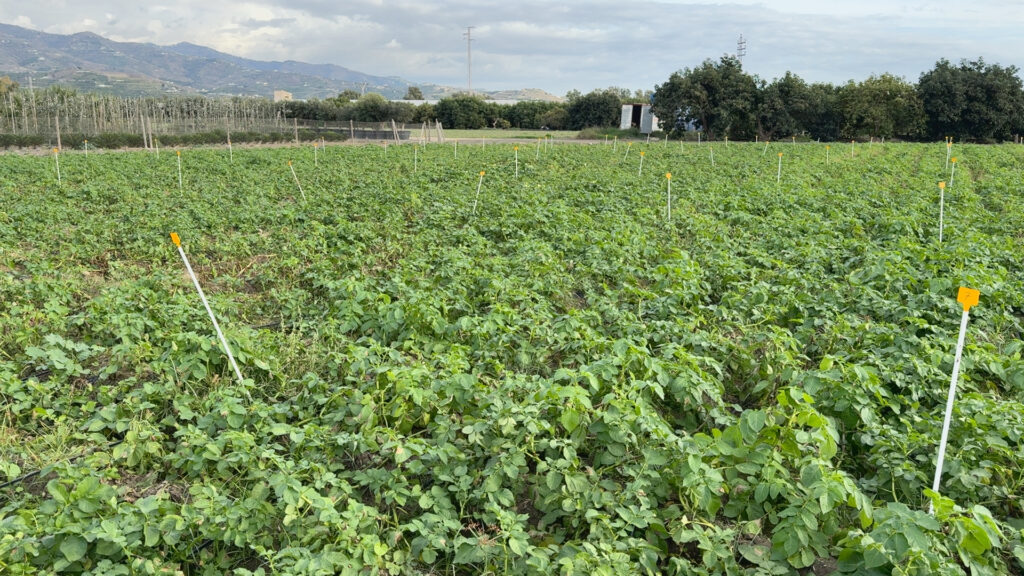
One of the trials visited was located in the province of Granada and corresponded to a potato crop at a pre-harvest stage. The objective of the study is to evaluate crop response under controlled water stress conditions, comparing different management strategies aimed at optimizing water use in the soil.
During the technical visit, several treated plots were analyzed, with particular attention paid to soil moisture content and the physiological status of the crop. Although final analytical data were not yet available at the time of the visit, direct observation made it possible to identify differences between treatments, providing relevant information for the subsequent interpretation of quantitative results.
This type of field evaluation is particularly useful for anticipating trends and contrasting visual observations with objective agronomic parameters.
Cherry tomato trials focused on improving fruit quality
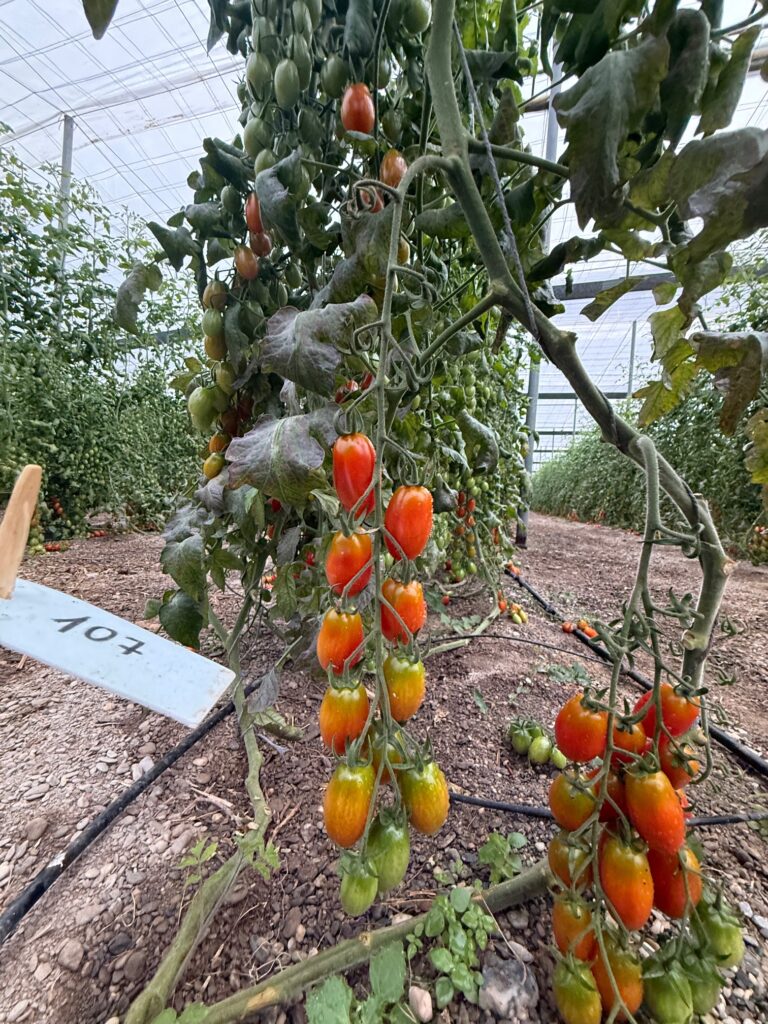
The day continued with a visit to a cherry tomato trial focused on evaluating products under development aimed at improving fruit quality. In this case, treatments were compared with well-established solutions, allowing crop responses to be contextualized in terms of productivity and quality.
Preliminary results shared during the visit showed increases in key parameters such as yield, Brix degrees, fruit size, and diameter. These data were jointly analyzed with the different participants, fostering a technical exchange aimed at assessing the agronomic relevance of the observed increases and their potential application under commercial conditions.
The analysis focused not only on the values obtained, but also on the coherence of crop responses from a physiological standpoint and on the consistency of the observed effects.
Analysis of water dynamics in different soil types
The final technical visit took place in the Murcia region, where a trial is being conducted across three soil types with specific characteristics. The objective of the study is to analyze water dynamics and distribution within the soil profile, comparing plots with and without the application of specific solutions.
Although the trial is still at an early stage and no preliminary results are yet available, the visit made it possible to explore key aspects related to water behavior in different soil profiles. Technical exchanges with soil specialists provided significant value for the future interpretation of the data and for strengthening knowledge in this area.
Technical validation and data-driven decision-making
Technical monitoring of field trials, together with collaboration with specialized external partners, is essential to ensure a rigorous evaluation of biostimulants. This approach makes it possible to integrate field observations, agronomic data, and plant physiology expertise, ensuring that development and product positioning decisions are based on objective and validated information.
Field trials conducted under real crop conditions therefore represent a key tool for advancing toward effective, consistent solutions that are aligned with the real needs of growers.
If you would like to receive further information or learn more about how we approach the agronomic validation of our solutions, we invite you to contact our team. Complete the form to receive technical information tailored to your needs.